
Creative journeys on my way to Jury Service
November was an unusual month for me as I was called for Jury service at Bristol Crown Court. The trial lasted four weeks. It was a fascinating experience, but it did take me away from the studio. Every day I would take the train from Bruton to Bristol, a three-hour round trip. I’d walk along Welsh Back to the Crown Courts. On my train journeys I made crayon drawings and on one occasion a little bit of graffiti on my carriage window brightened up a gloomy morning.
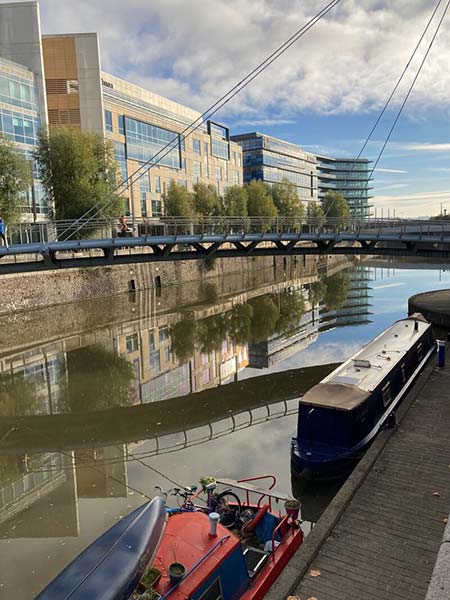
Welsh Back in Bristol
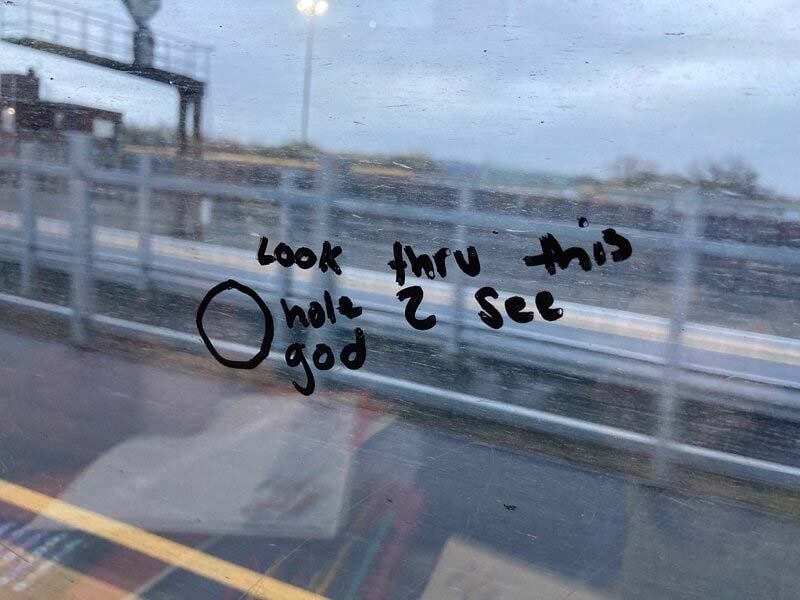
Grafitti on a train
Here is a selection of the drawings I made on my train journeys pinned up in my studio.
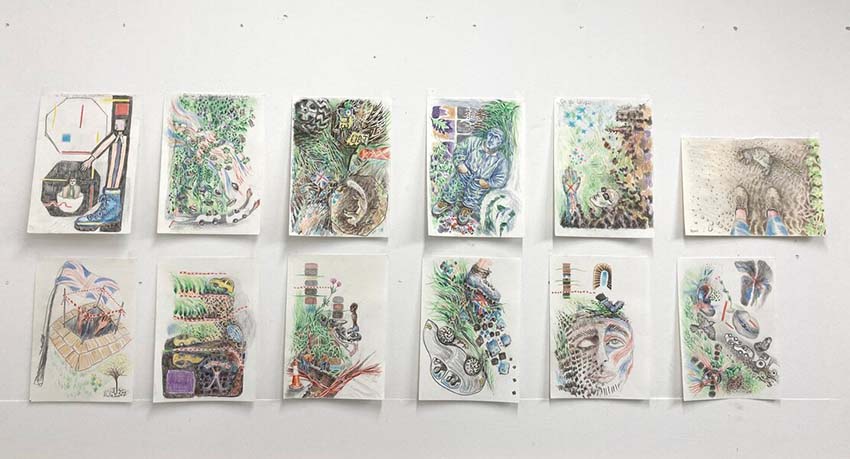
Photo of a collection of my “On the Verge” drawings
Before the trial I had already planned to start a new body of work inspired by the drawings I had made in the Spring of verges and hedges around my home in Yarlington, near Bruton.
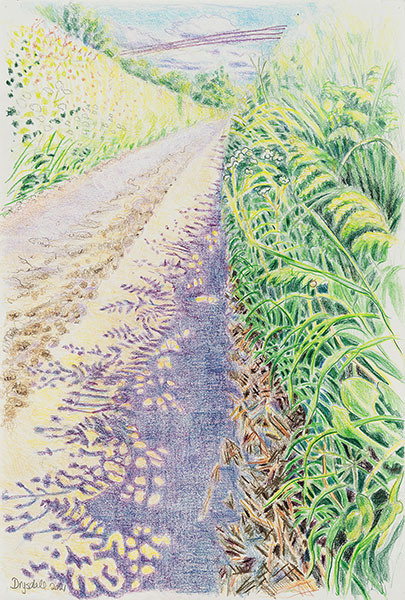
Yarlington Lane in Spring
Back to Painting
The plan was to now get back into painting, which for the last ten years had been supplanted by textile wall hangings, sculpture, installation and performance.
I had missed the illusionary magic of painting, the way the illusion can take you into another world for a brief moment of time. Whereas with sculpture and wall-hangings its physical presence dominates. I also missed the speed with which you can get an effect compared to in textiles. Five minutes spent painting can take four hours of embroidery. This speed enables me to generate many more images. My imagination feels more alive.
The final nail in the coffin for my textile and three-dimensional work was the huge practical problems of transporting and storing the work, let alone selling it. I am sure I will continue to make this sort of work, but not full time.
Jury Service, Bristol Crown Court, 1-30 November 2021
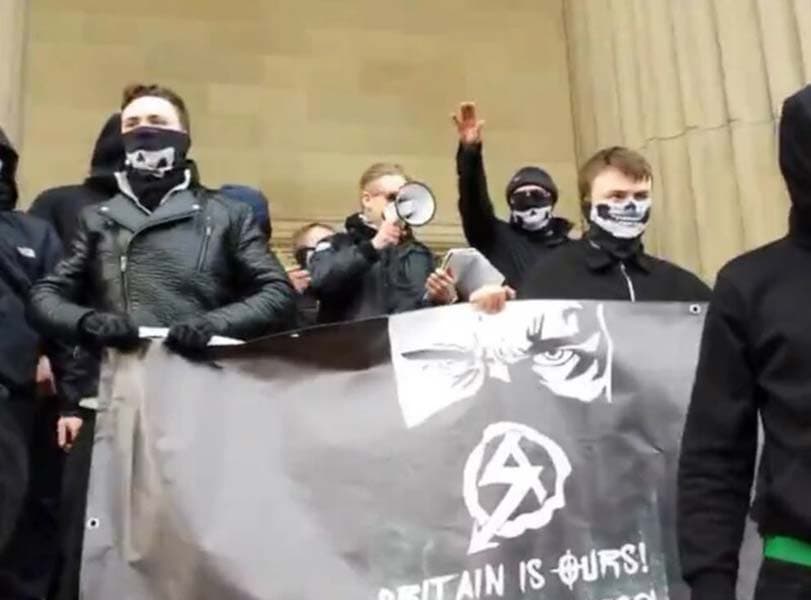
Photo of Benjamin Raymond speaking at a National Action demonstration in Liverpool in February 2016 (Bitchute)
The defendant was a 32-year-old man from Swindon called Benjamin Raymond. He had seven indictments against him. The most important of which was the accusation that he had participated in a Fascist terrorist organisation called National Action after it had been proscribed (banned) in 2016. It was the first Fascist group to be proscribed since 1939 when Oswald Mosley’s British Union of Fascists was proscribed. The other six indictments were that he was in possession of documents that were likely to be of practical use to a terrorist.
The trial had taken four years to come to court because of the huge amount of evidence to sort through by the West Midlands Counter Terrorism Unit. This mainly consisted of thousands of emails, texts and other forms of digital messaging stored on multiple hard drives.
During this four years 16 former members of National Action had been convicted. During its three years of legal existence there were only ever about 100 members.
The importance of the Raymond trial was made evident by the high-profile QCs: Barnaby Jameson for the Prosecution and Barra McGrory for the Defendant. Jameson has made a name for himself as an expert in terrorist trials, and Barra McGrory had formerly been Head of Crown Prosecutions for Northern Ireland, and as a QC had represented both Gerry Adams and Martin McGuinness, plus Paramilitary Loyalists.
Benjamin Raymond was the founder and mastermind behind National Action. Barnaby Jameson QC used a phrase invented by Raymond when he described the organisation as a “white jihadist group dedicated to an all-out race war”. He likened Raymond to the Nazi propagandist Joseph Goebbels, saying he fought “his holy war with words and images”.
Barra McGrory QC, defending, sought to differentiate between National Action and other terrorist groups.
“The views of the organisation are undoubtedly repugnant to many people in the UK,” he said. “This is an extremely small group of individuals which is not one that is actually engaged in violent terrorist activity. Neither is it one that has a structure in terms of being organised into cells in militaristic guerrilla warfare, such as al Qaida or the Irish Republican Army.”
You can read about the organisation and the trial from the following links:
The Jury gives their verdict
After four weeks of listening to evidence, the jury spent four days in deliberation. As a Juror I am not allowed to say what happened in the Deliberation Room but what I can say is that it was an intense, difficult and exhausting procedure, reading through five enormous bundles of documents in search of evidence that was “beyond reasonable doubt”. We all felt this great weight of responsibility. We were deciding on this man’s future life, and the life of his partner and one year old child.
There were 11 of us in the jury as one juror had stepped down due to catching covid. Judge Christopher Parker QC wanted a unanimous verdict but we were unable to get that, but he did accept a 10-1 verdict. We found him guilty of three out of 7 of the indictments.
The judge sentenced him to an eight-year prison sentence with a two-year extended period on licence.
Throughout the trial Raymond was smartly dressed and took copious notes. He often smiled at the proceedings and smiled at us the jury. There was an arrogance to him. It was only when the Foreman of the jury read out the verdict did he show any real emotion behind the arrogant defence. He turned red in the face and held onto a table to support himself. When he wiped his sweating brow his hand was shaking.
Sentencing by Judge Christopher Parker QC
I decided to go back to court to hear the judge’s summing up and the sentence. While waiting to be called into court I sat next to a young and pretty woman. I suspected that this must be Raymond’s partner and mother of his one year old child. I followed into court behind her. She often looked round at Raymond and they communicated with each other using hand signals. I tried to imagine what they must be feeling, the fear of what the sentence would be and how on earth they would survive it. I felt pity for them.
Barra McGrory QC, defending, tried to influence the judge’s sentence by telling him that since Raymond was first arrested four years ago the defendant’s “view of the world” had changed, having formed a stable and loving relationship and become a father. But this had no impact. He received the maximum, sentence for his crimes.
I looked at Raymond when he was sentenced. He was a shadow of his former cocky self. He wore a grey track suit and looked young and vulnerable. When the judge asked him to stand up to hear the sentence he shook and had to hold onto the table to steady himself. The judge asked him if he had understood the sentence and he faltered and said he hadn’t been able to hear what had been said so the judge had to repeat it. It was an awful moment. He was then lead away.
Being a juror on a major trial like this made me aware of my civic responsibilities towards our democracy in a way I had not felt before. To recognise that every prisoner who has been convicted, that their future life has been determined by a fellow citizen. It made me realise that us citizens are all in this together, doing our bit to uphold our democracy.
Jury service and my art
Has this experience affected my art? Well, before the trial, when I was making drawings of verges, one day I saw a little union jack lying in the verge. It was one of those kind that you may wave at a Royal Jubilee or at an international sporting event. It really held my attention. This little bit of detritus lying there discarded, but with such huge connotations, particularly post Brexit. I took a photo of it and knew I wanted to use it in my art.
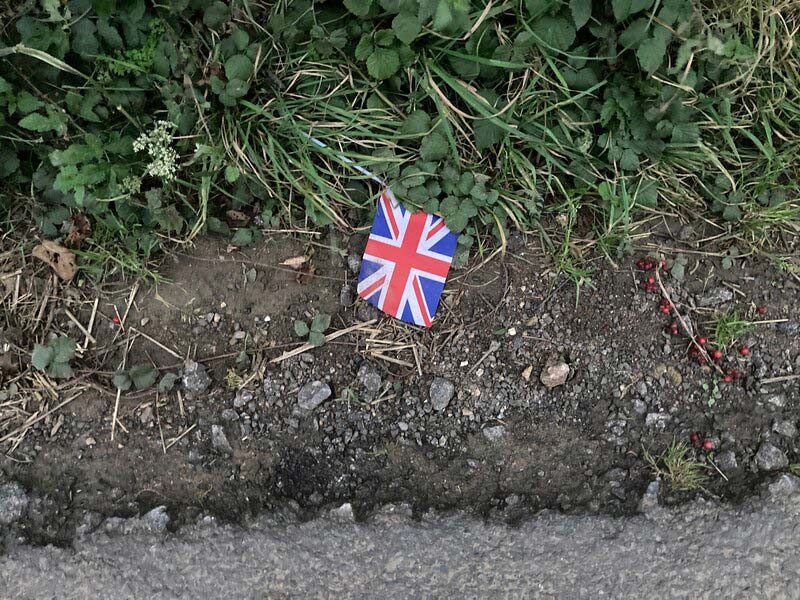
Union Jack in the verge
The trial showed how dangerous the Union Jack can be when it gets into the wrong hands. It made me consider the difference between Patriotism and Nationalism. Patriotism is a unifying force whereas Nationalism divides one group from another.
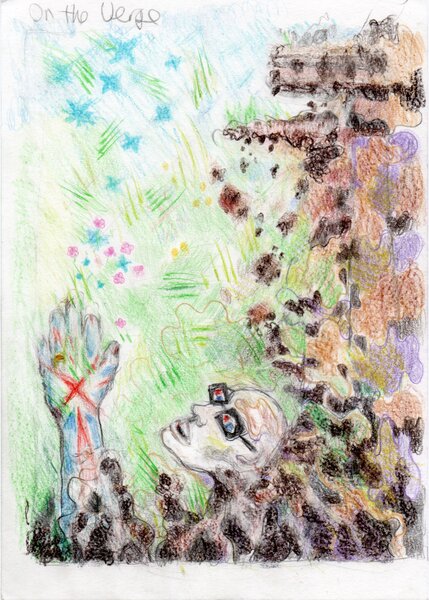
On the verge: nationalist comes up for air
The flag started to appear in my drawings. This is the first drawing I made. I imagined the Nationalist coming up for air out of the earth, looking through the lens of a Union Jack. I wondered if there is redemption for him, hence the stigmata engraved on his hand.
Careless Drivers
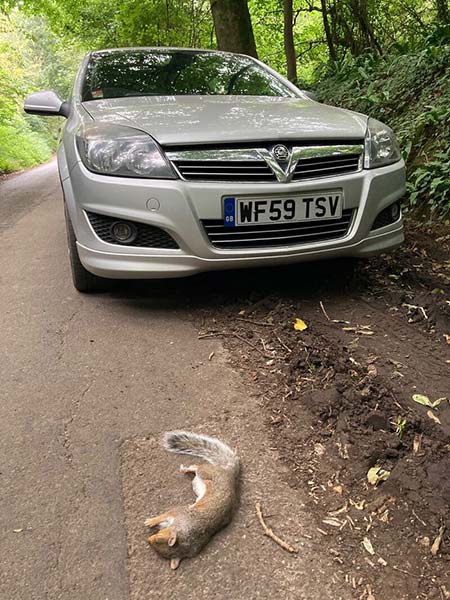
In the spring the wild flowers growing in the verge were so pretty, but I also would see dead animals that had been killed by careless drivers. One of those drivers was me. In the Autumn when the squirrels were very busy collecting and burying nuts they would frequently run across the road. One time I was driving too fast and hit a squirrel.
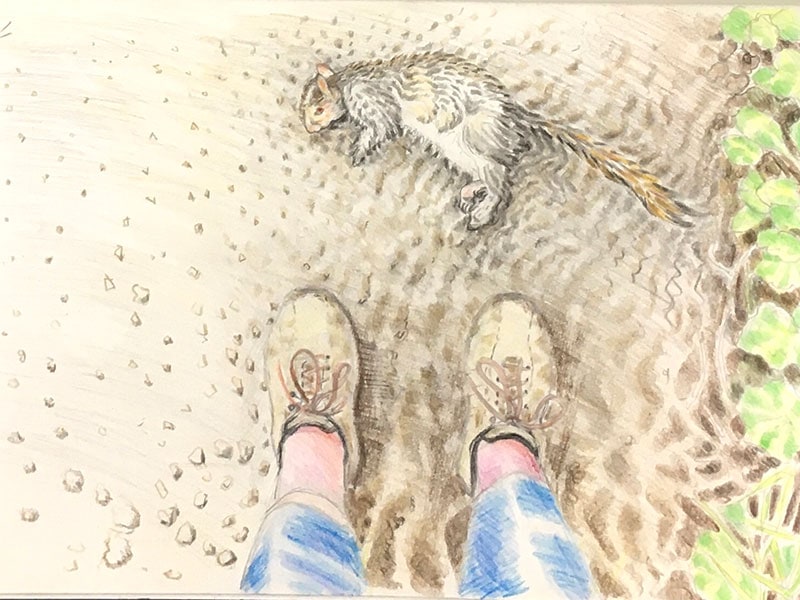
Drawing of a dead squirrel.
I made a drawing of the squirrel and then buried it.
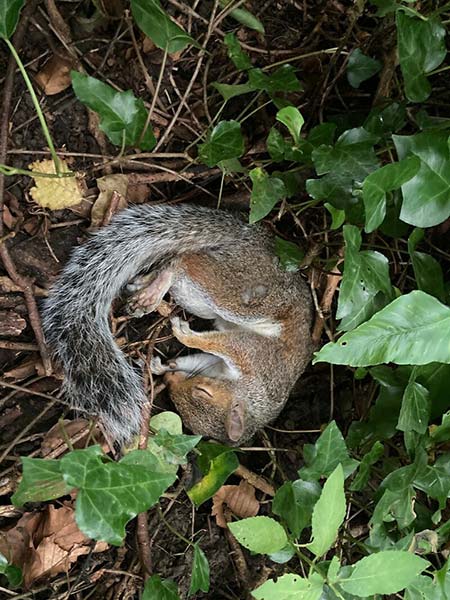
Detritus on the verge
I picked up other bits of detritus lying on the verge, one of which was a car number plate. I incorporated it into a drawing.
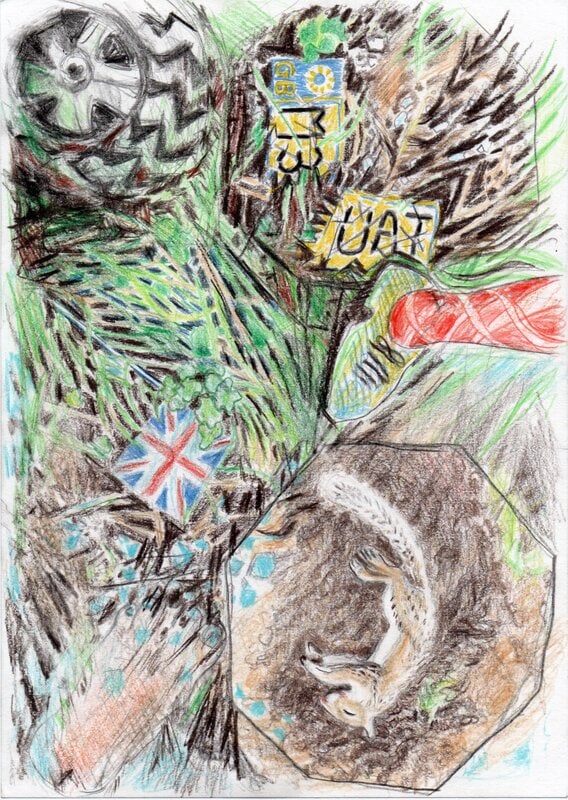
On the verge
Footwear
In some of the drawings there are boots, or high heels. Footwear express a particular type of relationship with their environment. Here is an example of the boot being used aggressively.
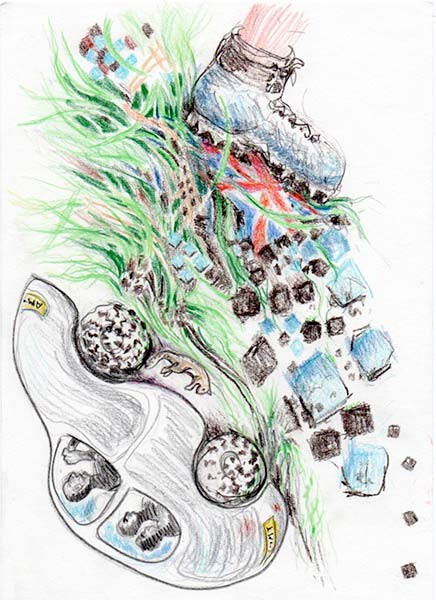
On the verge, boot and car, drawing
The Verge
Running through all these drawings is the theme of care and carelessness, gentleness and brutality, the manmade world and the natural world. The verge is the boundary between the manmade road and the natural hedge. It is where the two come together. Us humans have one foot in nature and one foot in the manmade world. We straddle the verge. Or you could say, the verge is where we feel at home.
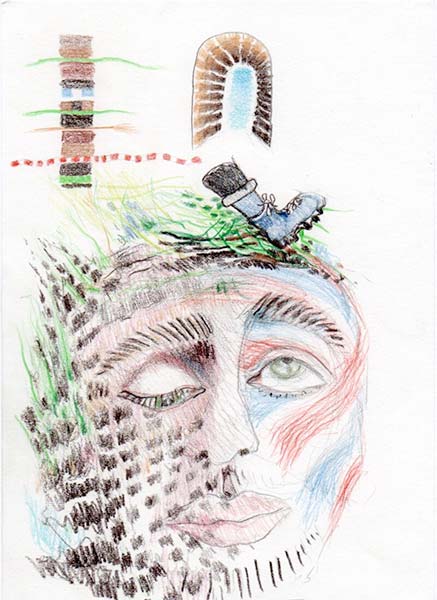
On the verge, face and flag, drawing
Here I consciously drew the face of the defendant in the trial, Benjamin Raymond. Despite his repugnant views, he had sensitive eyes and delightful bushy eyebrows. Half his face is in the verge looking downward, and the other is wrapped in the flag and looking up.
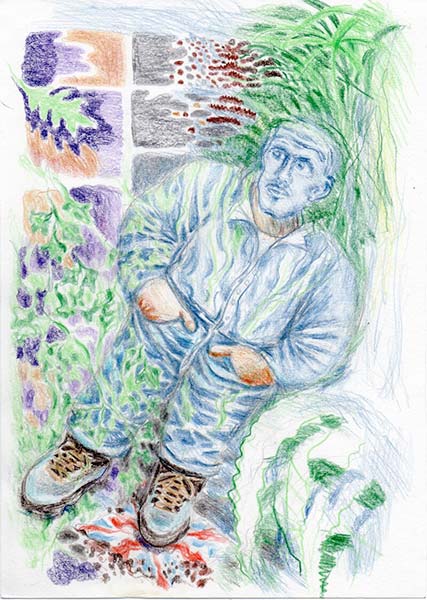
On the verge, man in denim, drawing
Following my intuition
While making these drawings, I am working intuitively. I cannot always explain the imagery. I trust what comes and work with it.
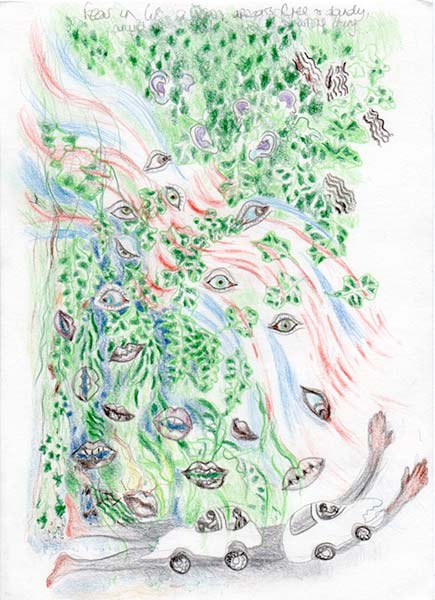
On the Verge: eyes ears and nose, drawing
In this one I was thinking about the fear people have in our liberal democracy of holding an unpopular opinion. So the hedge has eyes, ears and noses in amongst it. The flag crosses the hedge. Sometimes I will change my opinion of what the drawing is about. Its early days!
Watercolours
Besides making these drawings I have also started making watercolours. They have nothing to do with Verges or Union Jacks! Watercolour is a medium I do not use often but I’m drawn to its luminosity and lightness of touch. There’s an element of danger attached to watercolour because there is not much room for correcting mistakes. You have to be very alert and focused, doing what you know you have to do but also responding to unexpected occurrences and accidents. It’s a risky business, but when it works, it’s wonderful.
I’m very pleased with the way this one turned out. It’s called ‘Our yoga teacher told us to be at one with our duality’.
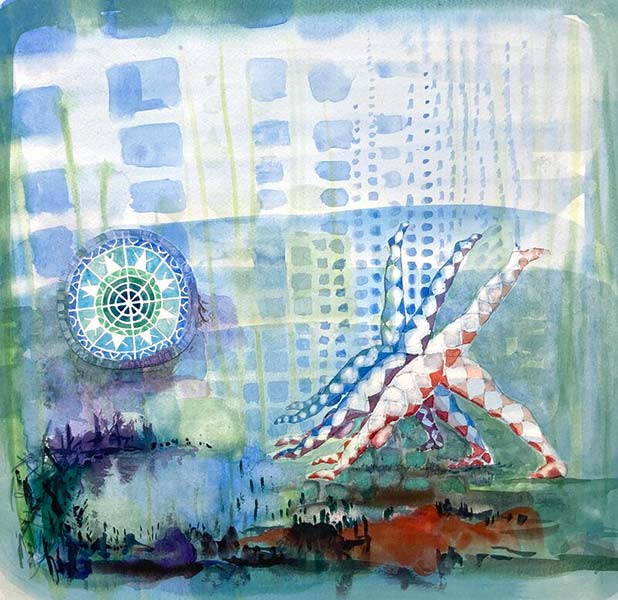
Our yoga teacher told us to be at one with our duality
I practice yoga and meditation. One day the teacher told us to be at one with our duality. I thought it was funny at the time, as I was struggling to hold a precarious pose, but it was also a profound bit of advice.
So this where the Blog ends. It’s been good for me to review what I’ve been up to it helps to clarify what I intend to do in the future. I hope you’ve enjoyed it and that you look forward to seeing how these drawings progress into paintings.
Till then, goodbye.
Alexandra